GENESIS 31
Exit Instead of Repair

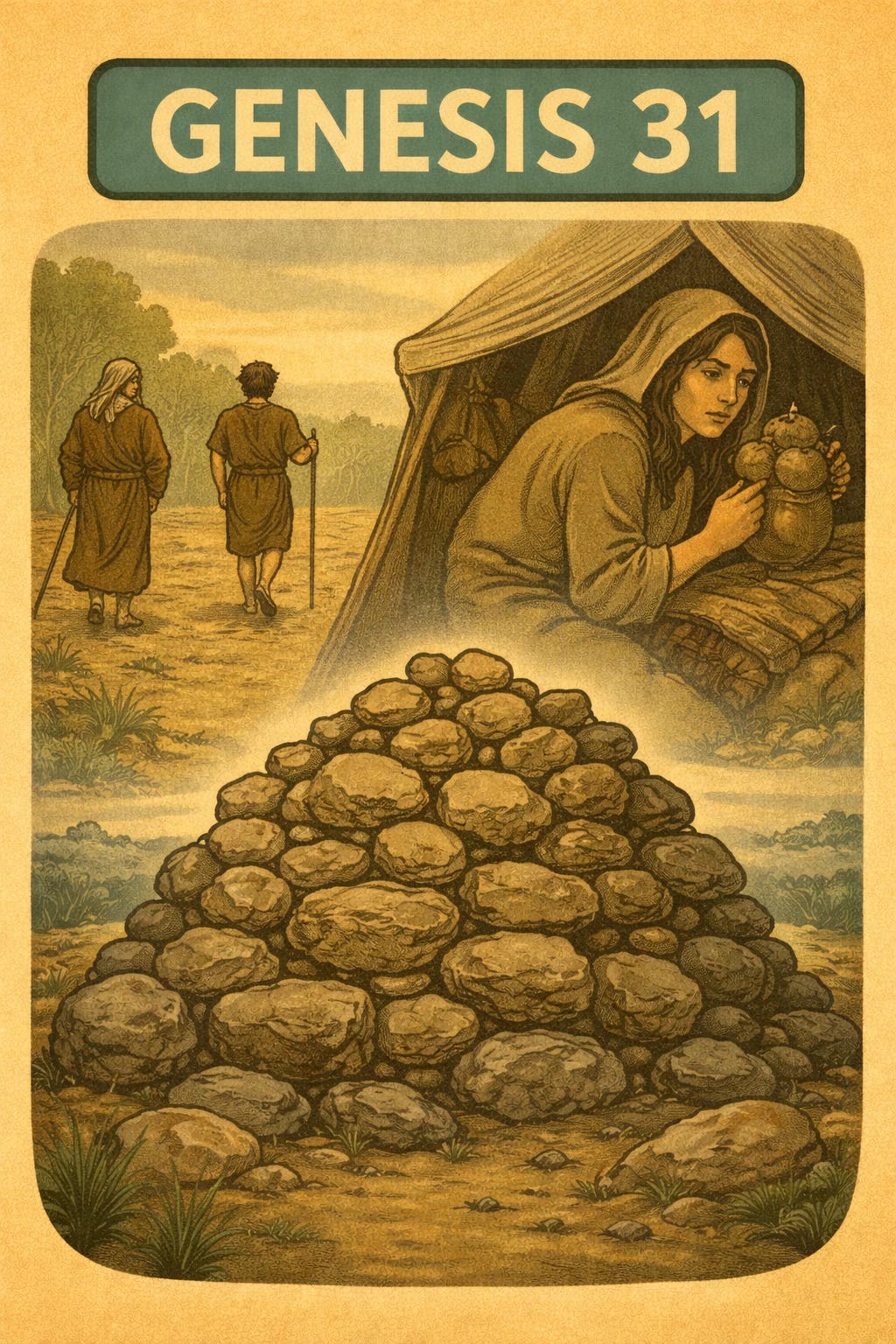
Genesis 31 begins with resentment.
Genesis 30 ended with increase. More flocks. More wealth. More household.
Now Laban’s sons notice.
“Jacob has taken all that was our father’s.”
Laban’s face changes.
The system that profited from Jacob’s labor now resents Jacob’s outcome.
This is not reconciliation.
This is backlash.
God Speaks, But Not to Fix What Happened
God appears to Jacob in a dream and gives a directive.
“Return to the land of your fathers, and I will be with you.”
God does not reform Laban.
God does not address twenty years of wage manipulation.
God does not demand justice.
God does not call Jacob to repentance.
God does not send Jacob back to make anything right.
God sends Jacob away.
The instruction is departure, not transformation.
When systems cannot be healed, departure becomes survival.
The Story Jacob Tells About Himself
Jacob gathers Rachel and Leah out in the field.
He recounts what Laban has done.
Wages changed repeatedly.
Labor exploited.
Outcomes manipulated.
His account is accurate.
But it is not complete.
He does not mention Esau.
He does not mention Isaac.
He does not mention the blessing taken through deception.
Jacob tells the story where he is wronged.
He does not tell the story where he wronged others.
Victimhood is true.
It is not the whole truth.
Jacob’s account is accurate about Laban’s manipulation.
But he omits his own history of deception.
The text lets him speak as victim without forcing self reflection.
Selective memory is a survival mechanism.
It is also how patterns persist.
Rachel and Leah Speak With One Voice
Rachel and Leah respond together.
“Is there any portion or inheritance left to us in our father’s house?”
“Are we not regarded by him as foreigners?”
“He has sold us, and he has indeed devoured our money.”
This is rare.
These sisters have competed through births, names, and bargaining.
Now, for a moment, they speak as one.
Not because the system healed them.
Because the system consumed them both.
So they agree to leave.
Not in confrontation.
In secrecy.
Rachel’s Theft
Rachel steals Laban’s household gods.
The text does not explain why.
Inheritance rights.
Security.
Superstition.
Defiance.
All possible. None confirmed.
The text records the theft and the lie without commentary.
The covenant line departs through concealment again.
Deception protects the promise, not purity.
But the pattern is familiar.
Rebekah deceived Isaac.
Jacob deceived Isaac.
Jacob manipulated Laban.
Now Rachel deceives Laban.
Deception migrates through generations and spreads sideways through relationships.
Even in departure, concealment persists.
Divine Containment, Not Correction
Laban pursues them for seven days.
He overtakes them.
Confrontation is imminent.
Then God intervenes.
Not publicly.
Not structurally.
Not through justice.
In a dream.
“Be careful not to speak to Jacob either good or bad.”
God’s intervention is minimal and pragmatic.
Violence is contained.
Exploitation is not.
God’s warning prevents bloodshed.
It does not address twenty years of manipulation.
The covenant is preserved through containment, not through moral correction.
The Search and the Lie
Laban searches the tents for his stolen gods.
Rachel hides them under a saddle.
She sits on them.
She lies.
“I cannot rise before you, for the way of women is upon me.”
She invokes ritual impurity as cover.
The lie works.
Concealment.
Performance.
Ritual used as shield.
The text does not condemn her.
The text does not praise her.
It records the method.
The Unknowing Curse
Jacob, confident and ignorant, makes a declaration.
“Anyone with whom you find your gods shall not live.”
He does not know Rachel took them.
He speaks death over the one he loves most without realizing it.
The text does not resolve the irony.
It lets the sentence hang.
Unanswered.
Unrepaired.
Anger Without Reflection
Jacob erupts.
“These twenty years I have been with you.”
“By day the heat consumed me, and the cold by night.”
“You have changed my wages ten times.”
He is right.
Laban exploited him.
But he never names the parallel.
He does not say, “What did I do to my father?”
He does not say, “What did I do to my brother?”
He does not say, “I know something about deception.”
He says, in effect, “Look what was done to me.”
Jacob speaks as victim.
He does not speak as perpetrator.
Covenant as Distance
Laban proposes a covenant.
They build a heap of stones.
They set up a pillar.
“This heap is witness between you and me.”
The last time Jacob set up a pillar, it was at Bethel.
There, a stone marked encounter and promise.
Here, stones mark separation.
The heap of stones is a boundary marker, not a reconciliation monument.
The treaty forbids future harm.
It does not address past exploitation.
Peace arrives through distance, not repair.
How This Is Usually Taught
Genesis 31 is often preached as righteousness rewarded or divine justice enacted.
Jacob finally escapes his exploiter.
God protects the faithful.
God warns the wicked.
That framing turns exit into vindication.
God does protect Jacob.
But the protection is containment, not correction.
No repentance.
No reconciliation.
No reckoning.
No transformation.
The family exits.
The patterns remain.
Theological Honesty
Genesis 31 does not show a household healed.
It shows a household relocated.
God protects Jacob.
God limits violence.
God keeps the promise moving.
God does not reform Laban.
God does not repair the damage.
God does not demand that Jacob confront his own history.
The covenant continues.
The dysfunction migrates.
The promise survives.
The people scatter.
And the text refuses to call that victory.
Not anti God.
Just anti BS.