GENESIS 32
The Night You Can’t Run From

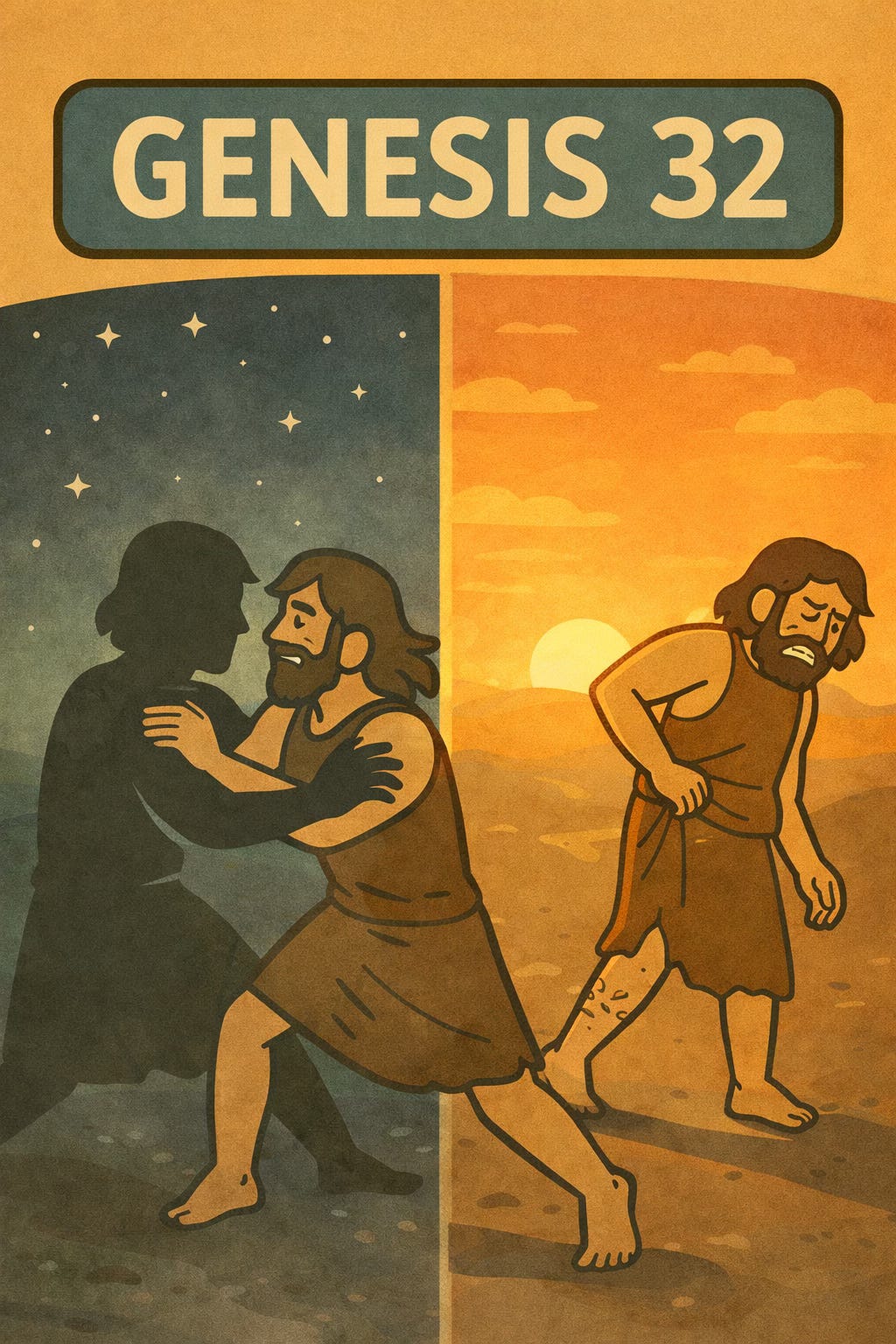
Genesis 32 does not begin with wrestling.
It begins with angels.
“The angels of God met him.”
Jacob names the place Mahanaim. Two camps.
Then the message comes back.
“We came to your brother Esau, and he is coming to meet you, and four hundred men are with him.”
Jacob is afraid.
Not the memory of Esau.
The man himself.
The brother he deceived.
The brother he fled.
The brother he never made things right with.
Nothing has been repaired.
Time has passed.
That is not the same thing.
Strategy Before Surrender
Jacob moves immediately.
He divides his household.
“If Esau attacks one camp, the other may escape.”
He sends gifts ahead.
Goats. Sheep. Camels. Cattle.
Wave after wave.
Each servant repeating the same message.
“These belong to your servant Jacob.”
This is not reconciliation.
This is risk management.
Jacob is not seeking forgiveness.
He is trying to control the outcome.
The Prayer That Follows the Plan
Then Jacob prays.
“O God of my father Abraham and God of my father Isaac… deliver me from the hand of my brother, from the hand of Esau, for I fear him.”
He invokes the promise.
He names his fear.
He reminds God, “You said, ‘I will surely do you good.’”
Jacob is not just praying.
He is negotiating.
Citing divine commitment as leverage.
But the order matters.
Strategy comes first.
Prayer comes second.
This is not surrender.
This is desperation layered on top of calculation.
Fear Has Always Been There
This is not new.
In Genesis 27, Jacob feared being caught.
In Laban’s house, he survived through timing and manipulation.
Now he fears Esau’s return.
Fear has always driven Jacob.
What changes here is simple.
Strategy is no longer enough.
Alone at Last
Jacob sends everything ahead.
Wives. Children. Possessions.
Everything that defined his status.
Gone.
For the first time, Jacob is alone.
No brother to deceive.
No father to manipulate.
No system to work.
Just Jacob.
And the dark.
The Fight
“A man wrestled with him until daybreak.”
The text calls him a man.
Jacob will later say he saw God face to face.
The blessing says he struggled with God and with men.
The identity is never clarified.
Man. God. Messenger. Presence.
All suggested. None confirmed.
What is clear is this.
The contact is physical.
The struggle is real.
No explanation.
No invitation.
Just resistance.
The Wound
The man touches Jacob’s hip.
It dislocates.
The hip is not random.
It is the center of strength.
The place tied to continuity and lineage.
Jacob is not killed.
He is not healed.
He is marked.
Permanently.
The limp is not symbolic humility.
It is literal damage from divine resistance.
Blessing arrives with injury.
Control has a limit.
And Jacob finds it in his own body.
The Same Hunger
“Let me go.”
“I will not let you go unless you bless me.”
This is not new.
Jacob has always wanted the blessing.
Before, he took it through deception.
Now, he refuses to release it through endurance.
Different method.
Same hunger.
And the posture remains.
Jacob still does not wait for blessing to be given.
He takes.
He holds.
He demands.
The form changes.
The instinct does not.
Say Your Name
“What is your name?”
“Jacob.”
He says it out loud.
The name tied to grabbing.
To supplanting.
To taking what was not his.
Then it changes.
“Your name shall no longer be Jacob, but Israel, for you have struggled with God and with men, and have prevailed.”
Israel.
One who struggles with God.
But the text keeps calling him Jacob.
The new name is given.
The old name remains.
This is not replacement.
This is layering.
The encounter changes his status.
It does not erase his patterns.
No Answers, Just Blessing
Jacob asks for a name.
He does not get one.
“Why do you ask my name?”
Then blessing.
No explanation.
No identity revealed.
No clarity.
Jacob receives a new name.
He survives the encounter.
He is told he has prevailed.
But he is not told what that means.
The encounter is real.
The understanding is withheld.
The Place Named
Jacob names the place Peniel.
“Face of God.”
“For I have seen God face to face, and yet my life has been delivered.”
This is Jacob’s interpretation.
Not a theological explanation.
He names the encounter.
And he names the outcome.
Not victory.
Survival.
Walking Toward What Isn’t Fixed
The sun rises.
Jacob limps.
The text records:
“Therefore to this day the people of Israel do not eat the sinew of the thigh.”
The wound becomes communal memory.
The injury becomes identity.
Jacob walks toward Esau.
Nothing has been resolved.
Esau remains ahead.
The past remains intact.
No apology has been made.
But Jacob is no longer untouched.
He carries the encounter in his body.
Echoes and Reversals
This moment mirrors everything that came before.
Jacob once grabbed Esau’s heel.
Now his own body is seized.
Jacob once took blessing through deception.
Now he demands it through endurance.
Jacob once fled alone.
Now he returns alone.
Jacob once saw angels in a dream.
Now he wrestles something he cannot define.
The reversals are real.
The continuities are just as real.
Fear persists.
Calculation persists.
The hunger for blessing persists.
But now there is a wound.
How This Is Usually Taught
Genesis 32 is often preached as transformation.
Jacob wrestles with God and surrenders.
Jacob is changed into Israel.
The old man dies. The new man emerges.
That reading smooths the edges.
It ignores the fear that remains.
It ignores the calculation that persists.
It ignores the limp.
The text does not.
Jacob is still afraid.
Jacob is still calculating.
Jacob is still managing outcomes.
Theological Honesty
Genesis 32 is not clean transformation.
It is confrontation that leaves a mark.
The name changes.
The limp remains.
Fear remains.
Strategy persists.
The past remains unresolved.
The encounter changes Jacob’s status.
It does not fully change his character.
God does not remove the conflict.
God meets him in it.
And leaves him altered.
Not whole.
Not fixed.
Marked.
The promise survives the night.
The man limps into the next day.
And the text refuses to call that wholeness.
Not anti God.
Just Anti BS