GENESIS 33
Reunion Without Resolution

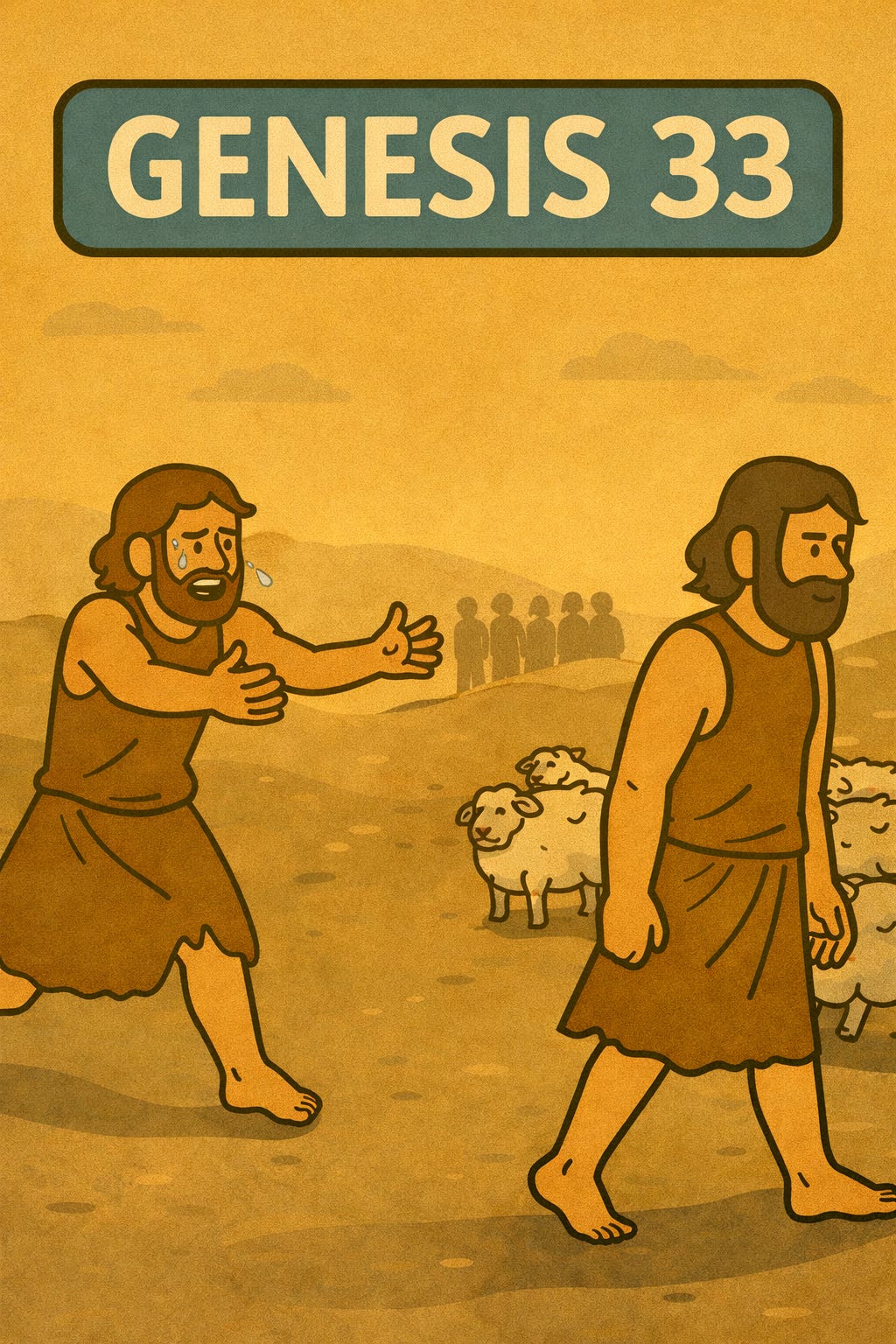
Content Note: This chapter discusses coerced reconciliation, family estrangement, and accountability avoidance.
Genesis 33 looks like the reconciliation everyone wants.
Two brothers.
Twenty years.
Violence avoided.
It reads like closure.
It is not.
When Transformation Doesn’t Take
Genesis 32 ends with a new name.
Israel. One who strives with God.
The night of wrestling is supposed to change everything.
Except Genesis 33 opens and keeps calling him Jacob.
The text calls him Jacob.
Thirteen times.
Israel?
Zero.
God gave him a new name the night before.
And the text refuses to use it.
That is not oversight.
That is narrative.
Whatever happened at the river
did not make him new.
It just marked him.
The Approach: Fear Still Leads
Jacob sees Esau coming with four hundred men.
And he arranges his family.
Servants first.
Leah and her children next.
Rachel and Joseph last.
This is not family order.
This is exposure hierarchy.
The most expendable go first.
The most valued stay back.
Fear is still structuring everything.
The Bowing: Performance Without Confession
Jacob goes ahead and bows.
Seven times.
It looks like humility.
It looks like surrender.
But he never says the thing that matters.
“I deceived you.”
“I stole from you.”
“I was wrong.”
The seven bows may look like humility.
The gifts may look like restitution.
But the text gives us posture and possessions.
Not confession.
Performing Submission Instead of Offering Repair
Seven bows is not just humility.
It is protocol.
Ancient Near Eastern diplomacy.
The way you approach a king.
But Esau does not want a subject.
He wants his brother.
And Jacob gives him performance instead of presence.
Hierarchy instead of equality.
Theater instead of truth.
You can bow yourself into the ground
and still never repair what you broke.
Esau’s Response: Real Grace
Esau runs.
Not slowly.
Not cautiously.
He runs.
Twenty years of anger could have landed as violence.
Four hundred men could have been vengeance.
Instead, he runs toward his brother.
Like he has already done the work.
Like he is ready.
He embraces.
He weeps.
He releases everything.
This is real.
Esau’s emotion is visceral and immediate.
Jacob’s response is posture, gifts, spiritual language, and polite deflection.
The text shows release from violence.
Not the rebuilding of trust or shared future.
When Theology Becomes Evasion
Jacob says something that sounds profound.
“Seeing your face is like seeing the face of God.”
But listen closely.
Genesis 32:30, hours earlier:
“I have seen God face to face, yet my life has been delivered.”
Jacob just wrestled with God.
He named the place Peniel. Face of God.
He knows exactly what that means.
So when he tells Esau the same thing
this is not spontaneous insight.
This is calculated language.
Theology used as deflection.
Because he still does not say the simple thing.
“I wronged you.”
When Gifts Replace Words
Jacob offers gifts.
Livestock. Wealth.
The Hebrew word is the same word used for offerings to God.
He presents them like a sacrifice.
But Esau does not need an offering.
He needs acknowledgment.
Restitution without confession is expensive silence.
You can pay for what you took.
You still have not owned what you did.
“You Go Ahead”: Distance Disguised as Wisdom
Esau offers something real.
“Come with me.”
Travel together.
Rebuild something.
Jacob declines.
The children are weak.
The animals are slow.
It sounds reasonable.
It is also strategic distance.
Esau offers proximity and restored relationship.
Jacob chooses separation.
Peace is achieved through divergence.
Not reunion.
The Lie That Ends the Meeting
Jacob says he will follow.
He says he will meet Esau in Seir.
He does not.
Esau goes to Seir.
Jacob goes to Succoth.
Different routes.
Different regions.
Different futures.
Then Jacob settles.
He builds.
He stays.
He was never planning to follow.
The lie was complete before Esau was out of sight.
When Grace Gets Rejected
Esau offers everything.
Companionship.
Protection.
Restored relationship.
Jacob accepts none of it.
One brother came ready to rebuild.
The other came ready to survive.
That is not reconciliation.
That is one person healing
and the other still hiding.
The Last Time
This is the last time Jacob and Esau share the story.
The next time they appear together
is at their father’s burial.
No conversation.
No repair.
Whatever could have been rebuilt here
never is.
What Actually Happens Here
Genesis 33 resolves tension.
It does not resolve history.
No confession.
No repair.
No rebuilding.
Just two men who meet.
And then separate.
Esau lets go of the knife.
Jacob leaves.
That is survival.
Not healing.
Dropout Reflection
Churches love Genesis 33.
They call it reconciliation.
Healing.
Restoration.
Except the text does not support that.
There is no confession.
No acknowledgment of harm.
No rebuilding of trust.
No shared future.
What the text shows is this:
One brother releases the past.
The other avoids it.
One offers relationship.
The other creates distance.
This is not reconciliation.
It is de-escalation.
And calling it reconciliation is dangerous.
Because it teaches people that gestures without accountability are enough.
That peace without repair is healing.
This is the language abuse hides behind.
“I apologized.”
“I made it right.”
“Why can’t you just move on?”
Genesis 33 dismantles that theology.
Victims are told to forgive without acknowledgment.
To accept gestures as repair.
To move on because the person who harmed them showed up.
Jacob walks away feeling like it is resolved.
Esau walks away alone.
That is not restoration.
That is release without repair.
Reflection Questions
Where have you seen apology without accountability?
What does it cost someone when their grace is not met with honesty?
Have you accepted distance and called it healing because facing the truth was harder?
Who in your life has bowed, gifted, and spoken well but never actually said, “I was wrong”?
What does it say about Jacob that he would rather lie than risk staying?
Not anti God.
Just anti BS.
This may be my favorite one yet. Speak louder for the people in the back 🗣️