GENESIS 34
When Honor Demands Blood

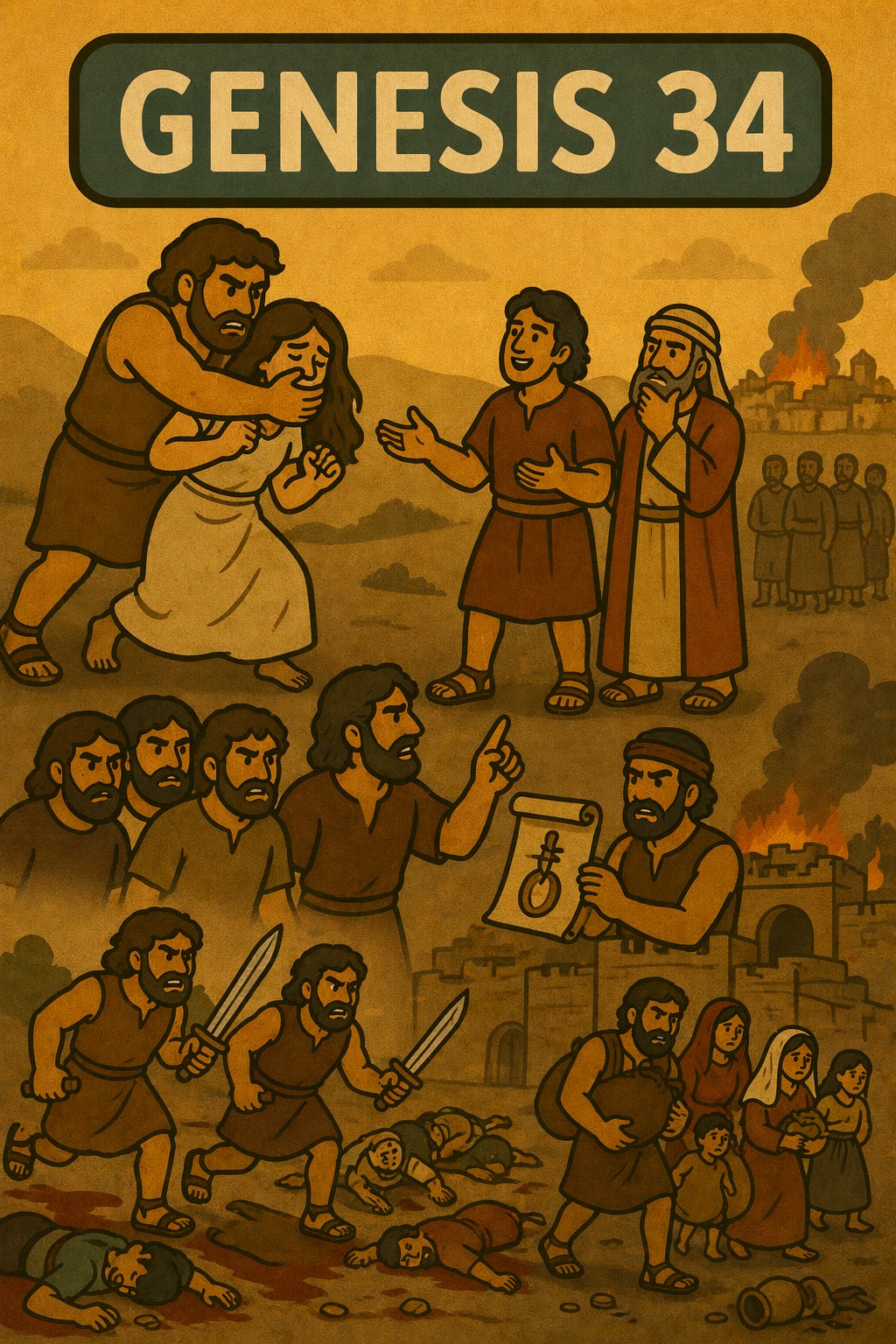
Content Note: Genesis 34 records sexual violence, retaliatory massacre, and the plunder of an entire city.
Genesis 34 does not begin with explanation.
It begins with action.
A daughter goes out.
A man takes her.
Men negotiate.
Brothers retaliate.
And the person most harmed
never speaks.
She Went Out
“Dinah… went out to see the women of the land.” (34:1)
That’s all the text gives.
No warning.
No moral framing.
No blame.
The text assigns no fault to Dinah for going out.
Curiosity is not consent.
Movement is not invitation.
What follows is not caused by her.
It is chosen by someone else.
He Took
“When Shechem… saw her, he took her and lay with her and humbled her.” (34:2)
Three movements.
He took.
He lay with.
He violated.
The text does not soften this.
And it does not pause here.
It keeps going.
Then He Loved Her
“His soul was drawn to Dinah… he loved the young woman and spoke tenderly to her.” (34:3)
Love language appears
after the act of violence.
Tenderness follows force.
A proposal follows assault.
“Ask me for as great a bride-price as you will.” (34:12)
The text does not resolve this contradiction.
It records it.
Affection after violation does not redeem the act.
It attempts to legitimize possession.
And Dinah Says Nothing
Dinah never speaks.
Not once.
No grief.
No anger.
No consent.
No refusal.
The entire chapter moves around her.
Men act.
Men decide.
Men negotiate.
Men avenge.
And she remains at the center
without ever being given a voice.
A Father Who Waits
Jacob hears what happened.
The text says he “held his peace until they came.” (34:5)
There is a reason given.
His sons are in the field.
But notice what follows:
He does not go to Dinah.
He does not confront Shechem.
He does not speak when negotiations begin.
His sons speak.
Jacob listens.
The text does not call this wisdom.
It records silence.
Turning Violence Into a Deal
Hamor and Shechem come with a proposal. (34:6–12)
Marriage.
Intermarriage.
Shared land.
Economic integration.
“The land shall be open to you.”
“Ask me for as great a bride-price as you will.”
The violation is not confessed.
It is not repaired.
It is negotiated.
Dinah becomes part of the transaction.
The harm becomes leverage.
The Brothers Respond
The sons return.
“They were indignant and very angry… this should not be done.” (34:7)
The outrage is real.
Then the text names the method.
“The sons of Jacob answered… deceitfully.” (34:13)
Anger is present.
Deception follows.
The violation is targeted.
The response will not be.
Deception Dressed as Faith
They demand circumcision.
Every male.
Join us. Become like us.
Then we will give her.
It sounds covenantal.
It sounds righteous.
The text calls it something else.
Deceit.
The brothers’ anger is understandable.
The violation was real.
But the response does not stay with the guilty.
Faith becomes leverage.
Identity becomes a weapon.
Jacob deceived his father.
Now his sons deceive a city.
The pattern did not die.
It multiplied.
The Third Day
On the third day, when the men are in pain (34:25),
two brothers move.
Simeon and Levi.
Full brothers to Dinah.
They enter the city.
They kill every male.
Not just Shechem.
Not just Hamor.
Every male.
Then the others follow.
They plunder.
Wealth.
Livestock.
Women.
Children.
Violence does not stay contained.
It expands.
Dinah Is Taken
“They killed Hamor and Shechem… and took Dinah out of Shechem’s house.” (34:26)
Her removal happens during the massacre.
Not before.
Not after.
During.
No reunion.
No words.
No voice.
She is moved again.
From one place
to another.
Still without agency.
Jacob Finally Speaks
After all of it, Jacob speaks.
“You have brought trouble on me… I shall be destroyed, both I and my household.” (34:30)
His only recorded words.
Not grief.
Not justice.
Not Dinah.
Trouble on me.
Threat to me.
Fear for me.
Self-preservation, not protection, drives his response.
And That’s Where It Ends
The brothers answer:
“Should he treat our sister like a prostitute?” (34:31)
And the text stops.
No correction.
No resolution.
No divine response.
Just a question.
Hanging.
God Does Not Appear
Genesis 34 records:
Violation.
Negotiation.
Deception.
Massacre.
Plunder.
God does not speak.
God does not intervene.
God does not explain.
The narrator names deception.
The narrator does not name justice.
This is not a story about what God does.
It is a story about what people do
when harm happens
and no one stops them.
What This Story Refuses to Do
It does not resolve Dinah’s story.
It does not define justice.
It does not limit violence.
It does not call any of this healing.
A woman is violated.
A man tries to legitimize it.
A father remains silent.
Brothers retaliate with deception and massacre.
A city is destroyed for one man’s crime.
That is not justice.
That is escalation.
The Pattern Continues
Genesis 33 gave us peace without repair.
Genesis 34 gives us retaliation without justice.
Same family.
Same fracture.
Different outcome.
Same brokenness.
Theological Honesty
This chapter is often softened.
Spiritualized.
Justified.
“Defending honor.”
“Righteous anger.”
“Covenant justice.”
The text does not support that.
The violation is real.
The anger is real.
But the response is deception, massacre, and plunder.
Violence expands beyond the guilty.
Faith is used to justify harm.
And the one most harmed
is never centered in the response.
Not anti God.
Just anti BS